
Ask in plain words
Which agents need to recertify before AEP?
ATLAS answers from the records in InsuranceOps, with a link to each source.
Production against goal, your agent hierarchy, every new-business case, the book, commissions and compliance, in one private command center with your agency’s name on it. ATLAS, the built-in AI assistant, reads your data and shows your team what needs attention today.

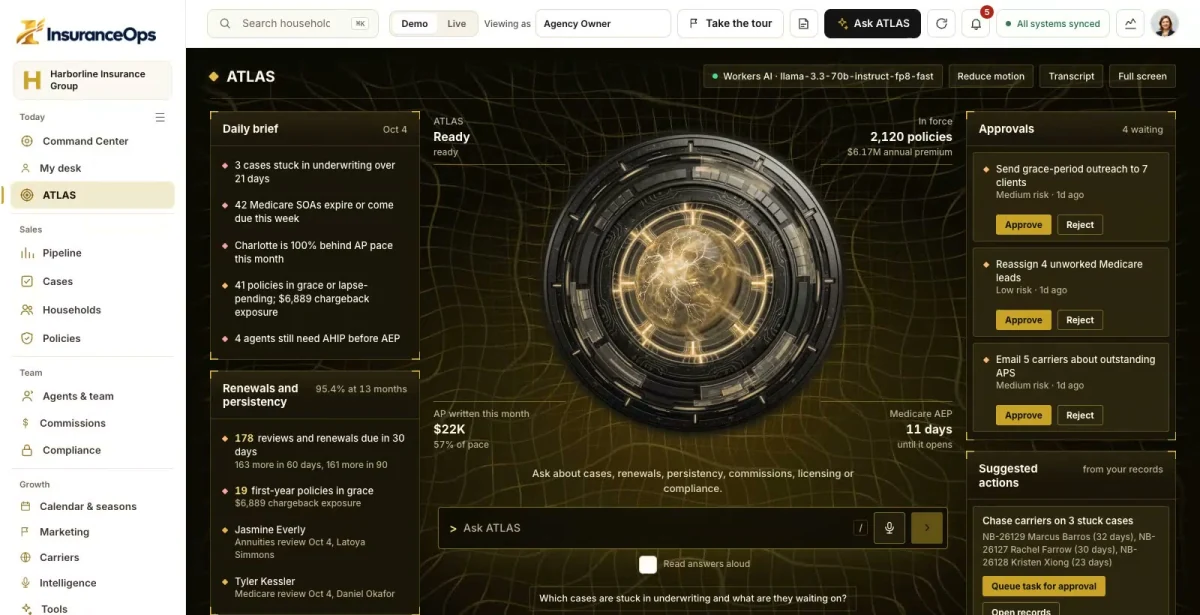
Ask about anything in InsuranceOps. ATLAS answers from your own records, shows the evidence and suggests the next useful step.
ATLAS works inside your role and the permissions your team sets.

Which agents need to recertify before AEP?
ATLAS answers from the records in InsuranceOps, with a link to each source.
Which cases are stuck in underwriting and why?
The answer brings the related records, owners and dates together before anyone decides.
Drafts, messages and record changes wait for a person to approve them, and every completed action has a receipt.
Round-robin distribution by license, appointment and capacity puts each lead in front of an agent who can write it.
APS, paramed and labs are tracked, and a case stuck longer than 21 days is flagged before anyone has to chase it.
Commissions, overrides and chargebacks trace back to the case, and the policy joins a book your team can see and protect.
Which cases are stuck?
Underwriting status lives in carrier portals, emails and sticky notes.
With InsuranceOps: A cases board flags anything stuck past 21 days, with the requirement it is waiting on.
Who isn’t appointed in Georgia?
Licensing lives in a spreadsheet someone updates when they remember.
With InsuranceOps: A licensing matrix by state shows expirations, appointments and gaps for every agent.
How big is our chargeback exposure?
Chargebacks show up on a statement weeks after the lapse.
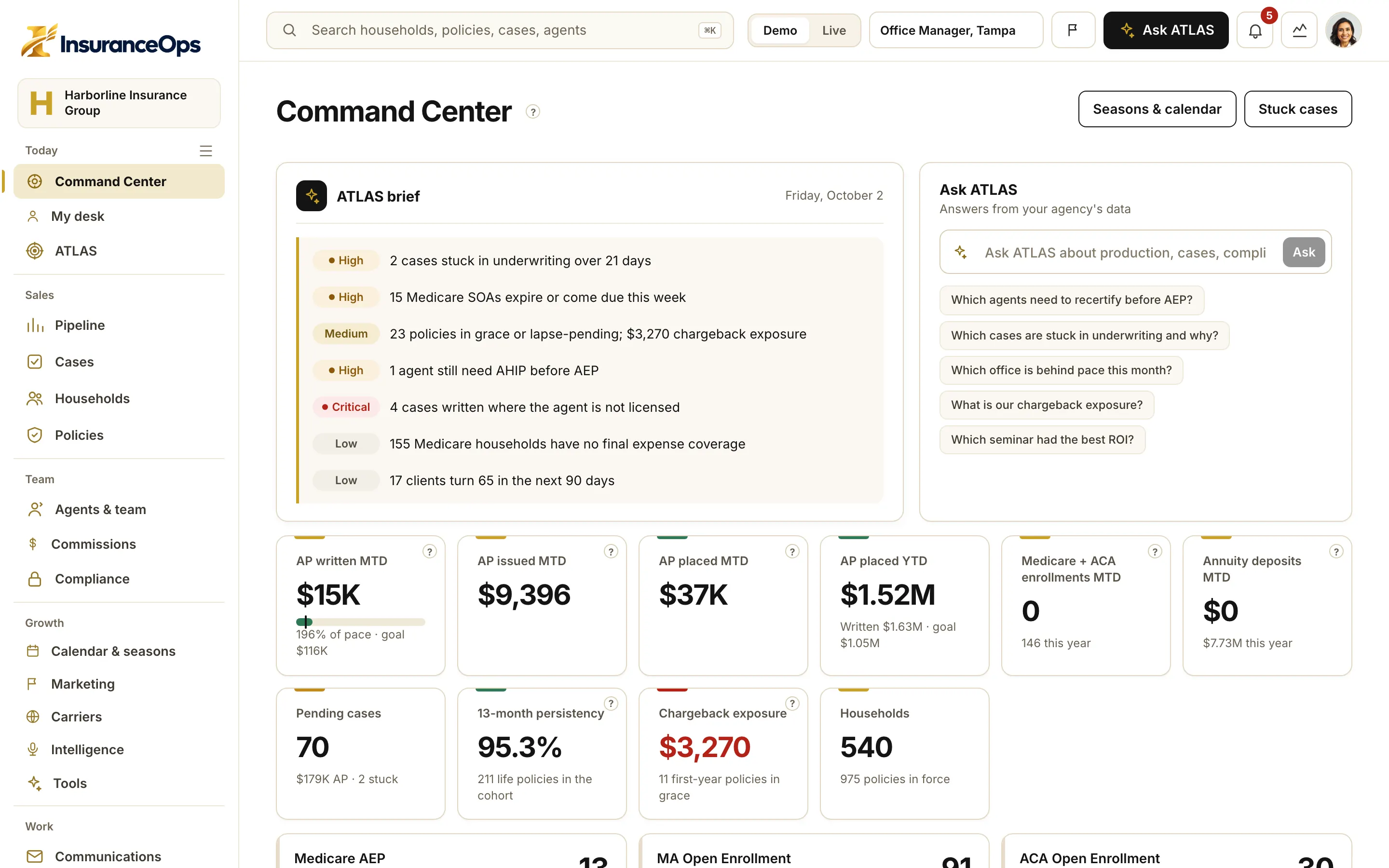
With InsuranceOps: Policies in grace, lapse-pending business and first-year chargeback exposure sit on the Command Center.
InsuranceOps shows what is possible. We shape the product lines, carriers, offices, hierarchy and workflows around your agency, and your team works in your brand.
Your logo, colors, carriers, product lines, offices and hierarchy. Your agency gets its own private copy with its own data.
Our goal is to reduce build cost by 70-90% versus a comparable from-scratch command center, by adapting an existing foundation instead of rebuilding every component.
Your proposal spells out the workflows, users, connections and any outside platform costs before you commit. We confirm the schedule once we know your systems, access and scope.
Savings target compared with a similarly scoped from-scratch build. Your quote and launch date depend on customization, integrations, data readiness and ongoing services. Complex builds take longer.
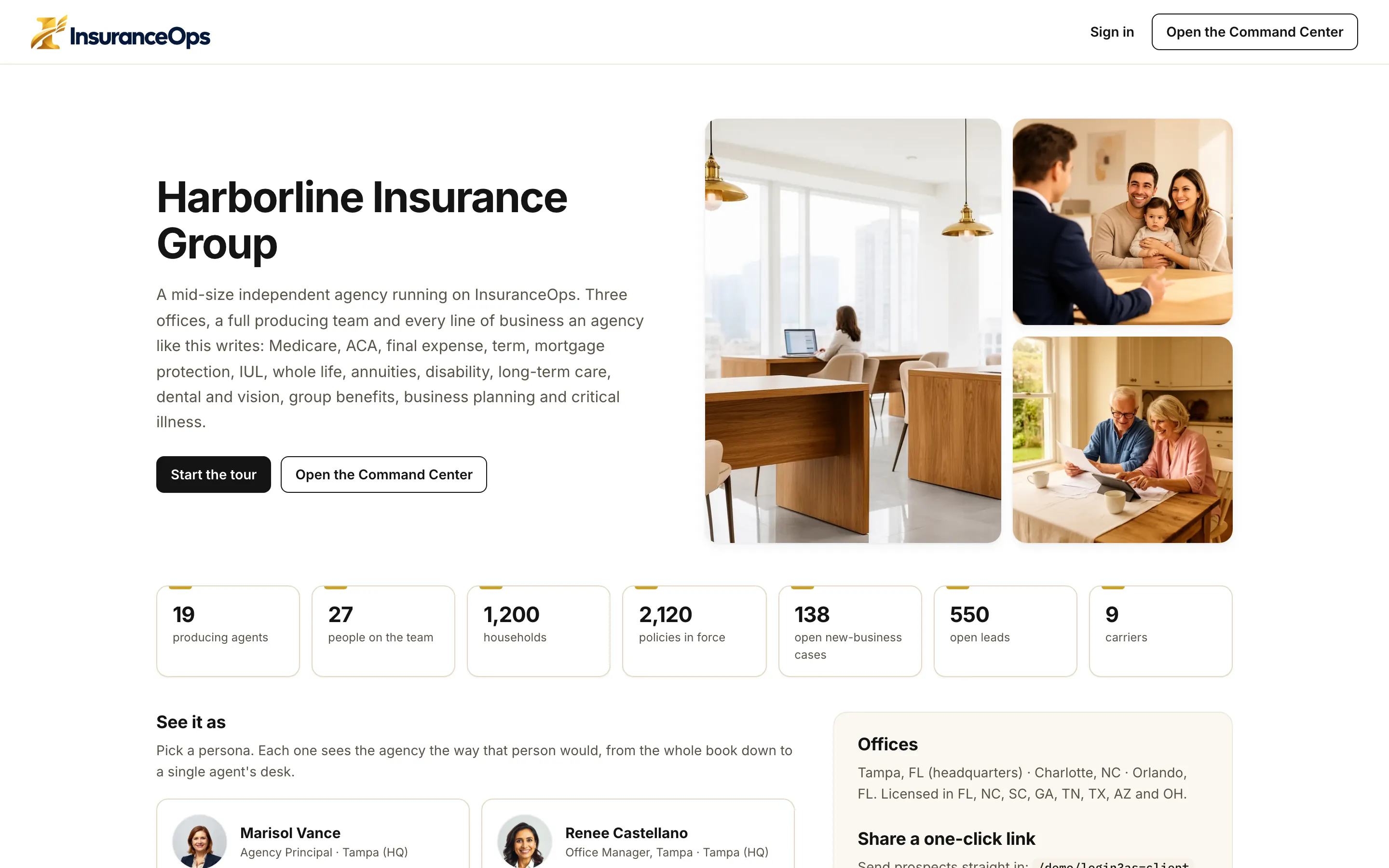
Built for independent agencies, IMO and FMO downlines, and Medicare, final expense and mortgage protection teams across 14 product lines.
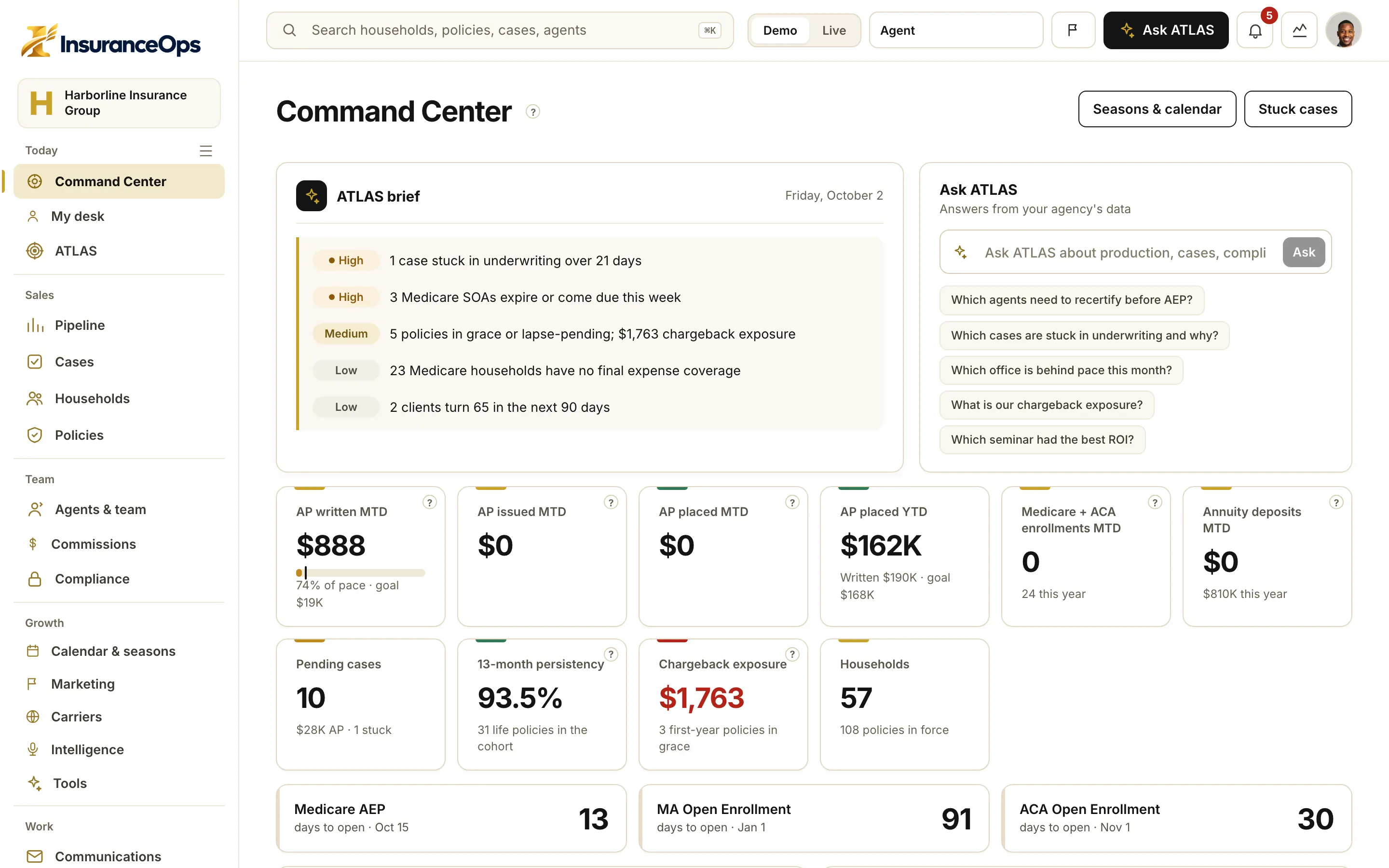
AP written, issued and placed against goal and pace, Medicare and ACA enrollments, annuity deposits, pending cases, 13-month persistency and chargeback exposure, with the AEP, MA OEP and ACA open enrollment countdowns on the same screen.
A visual hierarchy with production at every level, a licensing matrix by state with expiry dates, carrier appointments, AHIP and carrier certifications, E&O, CE, a recruiting pipeline and onboarding checklists.
The household 360 brings members, turning-65 dates, policies, beneficiaries, calls and notes together, and surfaces cross-sell gaps such as a Medicare client with no final expense coverage.
Each line has its own stages and speed-to-lead, with lead vendors measured by cost per lead, contact rate and aged leads, and round-robin distribution by license, appointment and capacity.
Follow each case through underwriting, approval, issue and delivery requirements. Cases stuck longer than 21 days rise to the top with the requirement they are waiting on.
Agent statements, advances and as-earned, chargebacks and debit balances, hierarchy overrides, splits, and Medicare and ACA renewals. Agency revenue by carrier and line stays owner-only.
The Medicare Scope of Appointment 48-hour tracker, TPMO disclaimer, call-recording retention, Do-Not-Call, annuity suitability and ACA consent, each with an owner and a date. It helps your team stay on top of the work and keep the record; it does not make anyone compliant on its own.
AEP, MA OEP, ACA open enrollment and special enrollment periods, turning-65 birthdays, policy anniversaries and RMD reviews, plus seminars from RSVP to AP and campaign results by channel.



Everyone signs in to the same agency and sees what their role needs. In the demo, switch seats with the Viewing as control.
Agency Owner. The whole agency, all three offices.
Office Manager. One office’s production, cases and people.
Agent. Their own book and cases, nothing else.
Compliance Officer. The compliance queue across the agency.
ATLAS writes the morning brief from your own data and answers questions with a link to where to act. Answers come from your agency’s records, not generic guesses.
People stay in charge. Replies, next steps and agent actions are drafts that wait for a person to approve them.
No sign-in. Start with the guided tour, then use the Viewing as switcher at the top of the demo to change seats. Data resets nightly.
We agree the connections in scope, build and test each one, and the Integrations screen shows its real state: connected, degraded or not configured. What each system can share depends on its API.
Yes. Every agency gets its own private copy of InsuranceOps: its own code, server and database, holding only its own data.
Yes. Your logo, colors, agency name, offices, carriers and product lines. Your team sees your brand, not ours.
Any carrier you work with. InsuranceOps tracks appointments, cases, policies and commissions by carrier. Commission data usually arrives as CSV statements, and we confirm what each carrier provides during scoping.
It doesn’t have to. InsuranceOps can sit on top of GoHighLevel and connect to it, or run on its own. We agree which in your proposal.
No software can do that on its own. InsuranceOps helps your team track and document compliance work, such as SOA timing, disclaimers, recordings and suitability, so nothing slips.
No. Harborline Insurance Group and everyone in it are fictional, and the figures are sample data, not results.
No. ATLAS drafts and suggests. A person reviews and approves anything that goes out or changes a record.
It depends on your users, offices and connections. Book a live demo and we will scope it with you; your proposal lists what is included and any outside platform costs before you commit.

Book a 15-minute live demo. We will walk through InsuranceOps with your offices, carriers and product lines in mind, and agree what a first scope could look like.
The same proven foundation, shaped for other industries. Not in one of them? We build yours.
 From first dispute to funded, for credit and funding companies.Explore FundingOps →
 Clients, documents, review and filing, for tax and bookkeeping practices.Explore TaxOps →
 Every dispute, every client, one command center, for credit repair companies.Explore CreditOps →
 Households, reviews and service promises in one cockpit, for advisors.Explore WealthOps →
 Every lead, deal and unit in one cockpit, for dealerships and dealer groups.Explore DealerOps →
 Customers, stock and margin-aware campaigns, for retail stores.Explore RetailOps →