
Ask in plain words
What should the team focus on today?
ATLAS answers from the records in CreditOps, with a link to each source.
Enrollment with CROA-aware agreements, report import, a 27-letter dispute engine with an FCRA-accuracy guard, dispute cycles, upsells, reports and ATLAS AI, in one private command center with your company’s name on it. Add CreditOps Club, an optional member add-on, to feed your team.

Ask about anything in CreditOps. ATLAS answers from your own records, shows the evidence and suggests the next useful step.
ATLAS works inside your role and the permissions your team sets.

What should the team focus on today?
ATLAS answers from the records in CreditOps, with a link to each source.
Which clients are ready for the next dispute round?
The answer brings the related records, owners and dates together before anyone decides.
Drafts, messages and record changes wait for a person to approve them, and every completed action has a receipt.
Lead, consult, plan and a written agreement with the required disclosures, then onboarding until the file is ready for round one.
Import the report, review the items, send accurate, honest letters and track every response by bureau and furnisher.
Optional offers for monitoring, builder loans and education, plus reports that show what is working.
Which bureau hasn’t answered?
Response dates live in notes, spreadsheets and a folder of letters.
With CreditOps: Dispute cycles with response timers, a calendar and an overdue queue for your analysts.
Is this letter safe to send?
Templates get copied and pasted, and an accurate item gets disputed as wrong.
With CreditOps: An FCRA-accuracy guard and a QA queue check every letter before it goes out.
Who is ready for the next offer?
Upsell chances are missed because nobody sees them.
With CreditOps: The Upsell Center shows who qualifies, what was offered and what it earned.
CreditOps shows what is possible. We shape the plans, agreements, letters, offers and member club around your company, and your team and members see your brand.
Your logo, colors, plans, letters, offers and member club. Your company gets its own private copy with its own data.
Our goal is to reduce build cost by 70-90% versus a comparable from-scratch command center, by adapting an existing foundation instead of rebuilding every component.
Your proposal spells out the workflows, users, connections and any outside platform costs before you commit. We confirm the schedule once we know your systems, access and scope.
Savings target compared with a similarly scoped from-scratch build. Your quote and launch date depend on customization, integrations, data readiness and ongoing services. Complex builds take longer.
Built for credit repair companies and credit restoration agencies that run on tools that don’t talk to each other.
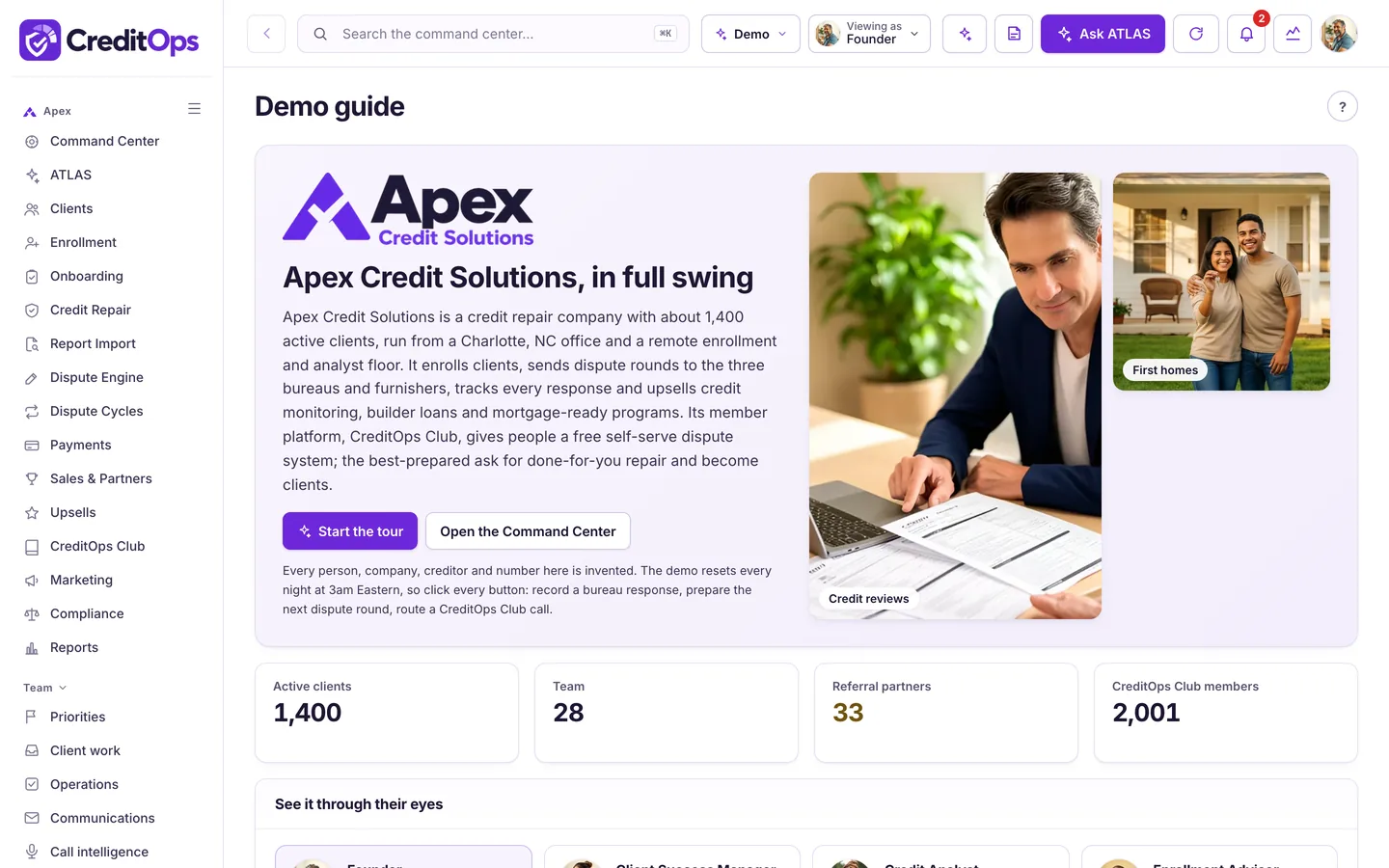
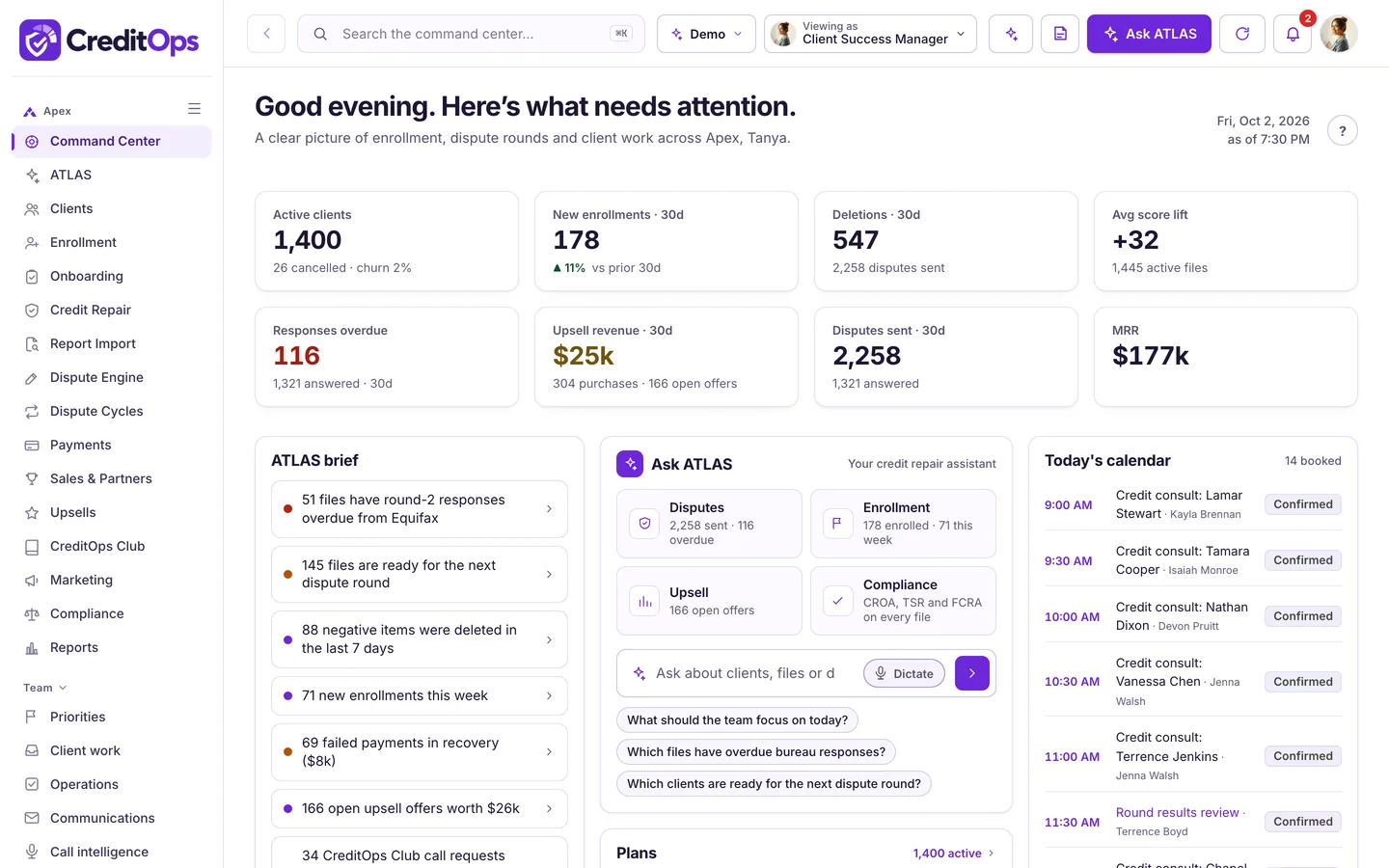
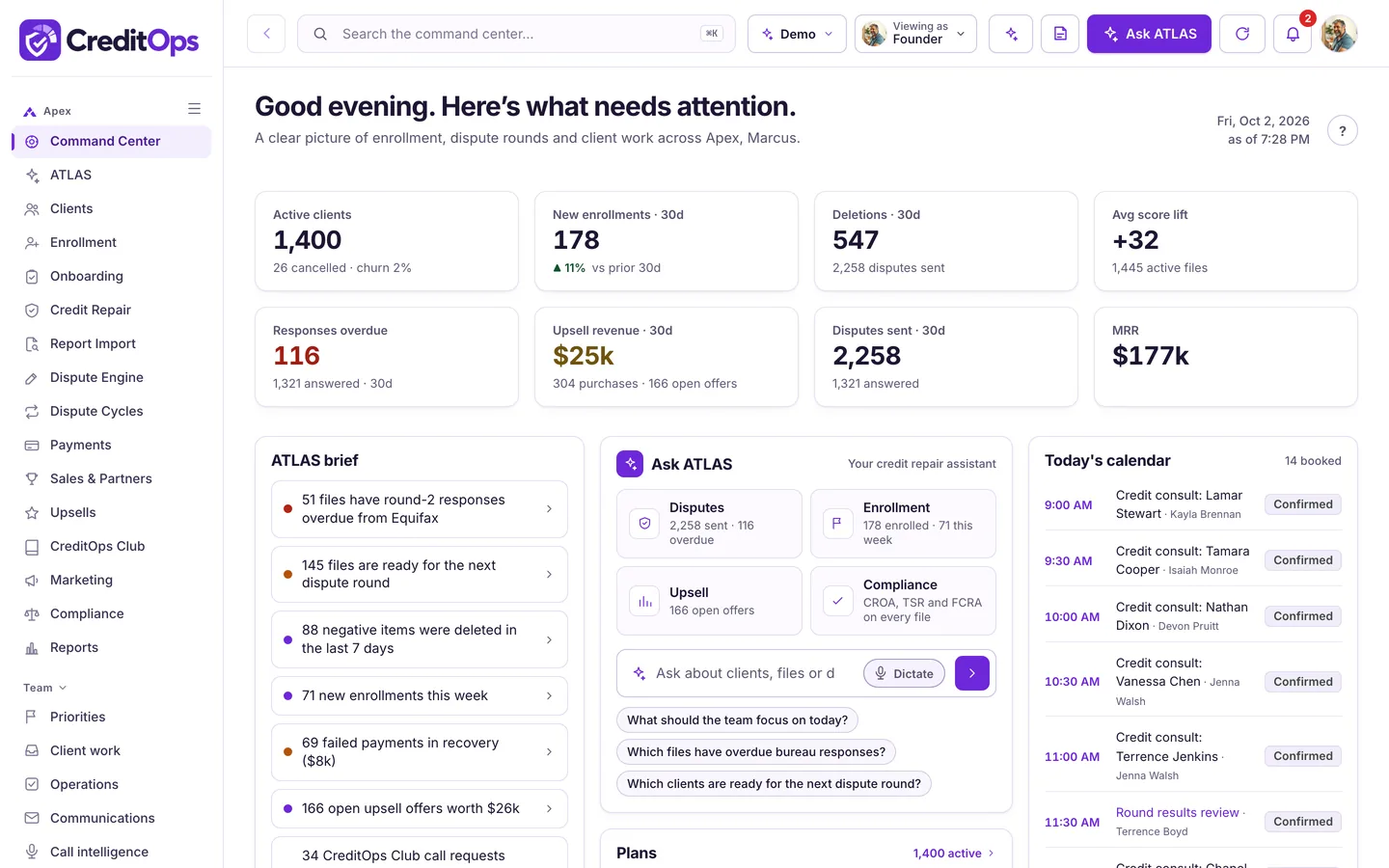
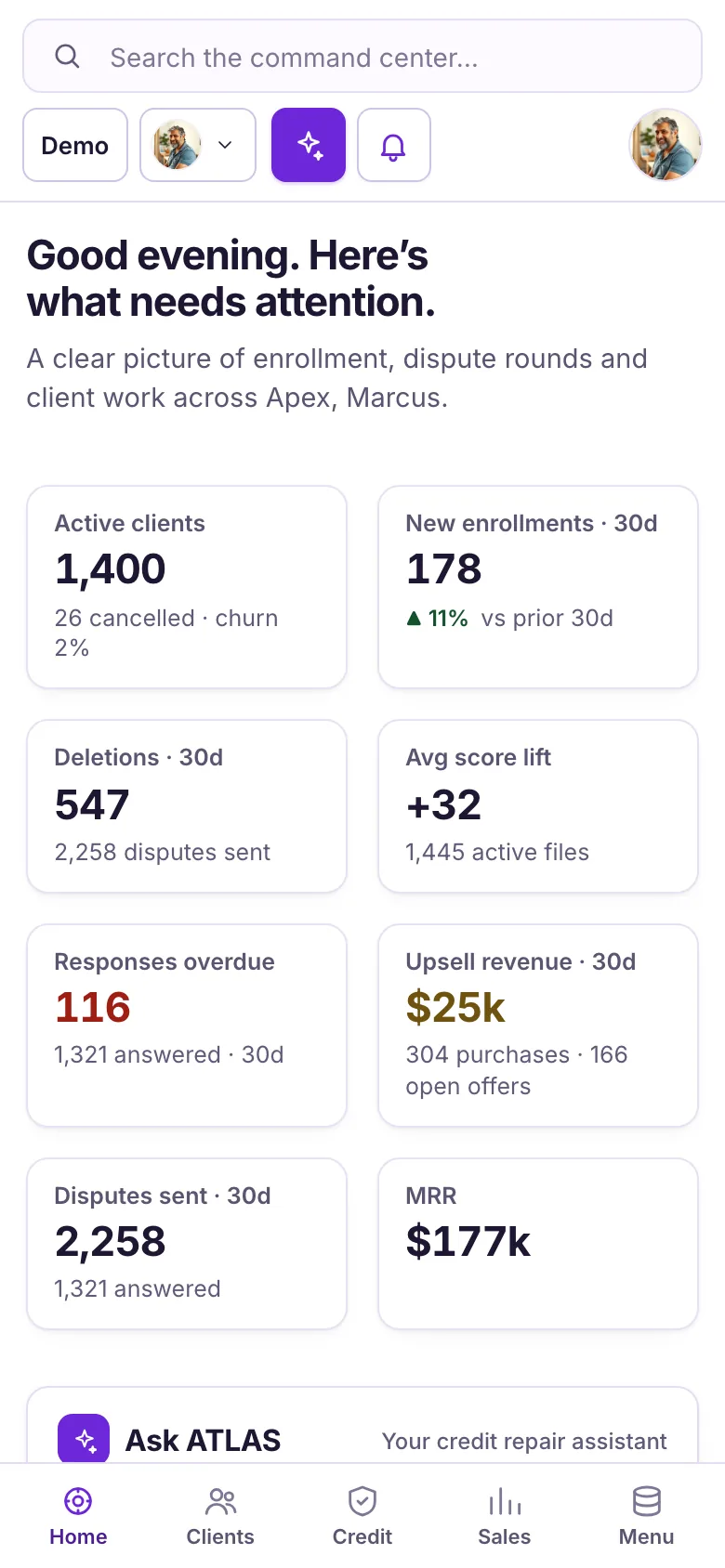
Active clients, new enrollments, deletions, responses overdue, upsell revenue and monthly recurring revenue, with the ATLAS brief and today’s consults beside them.
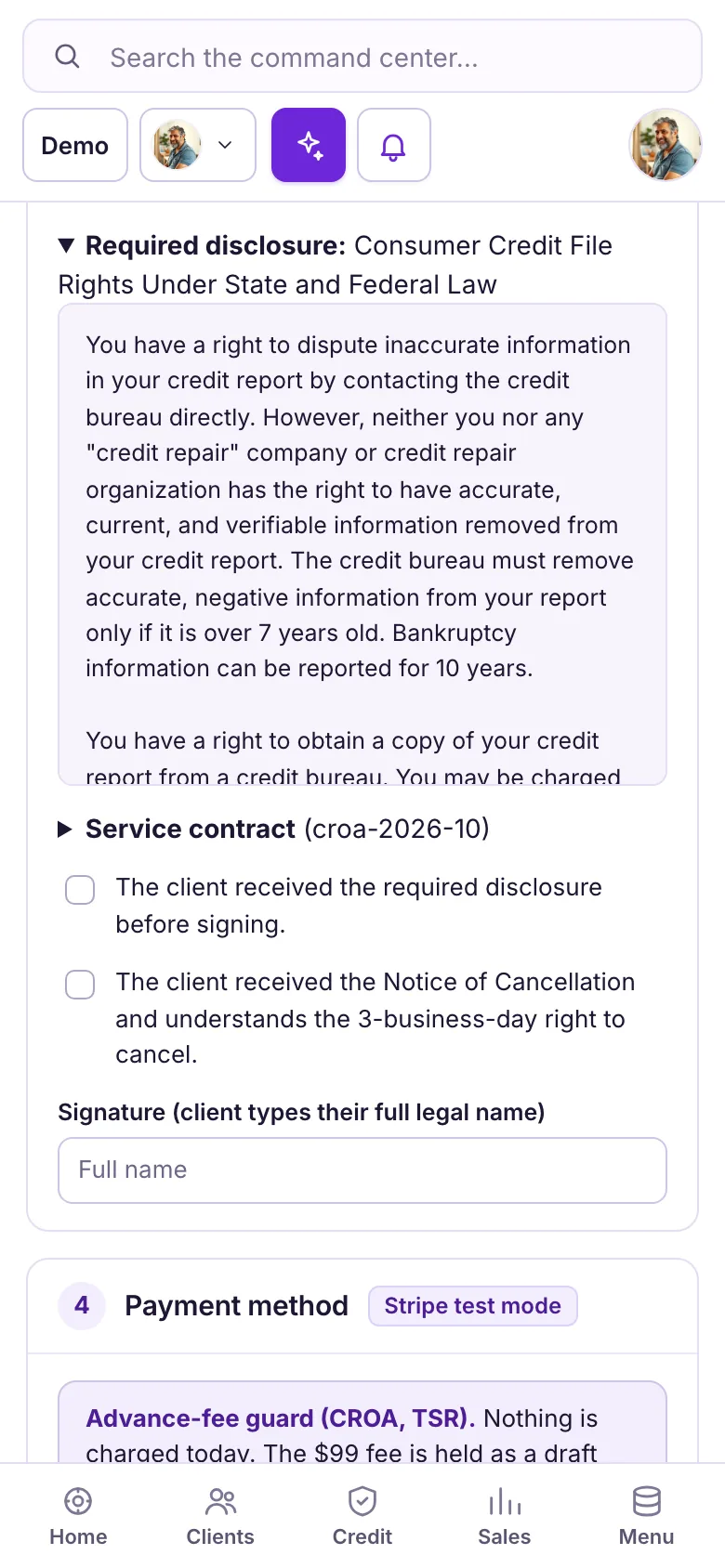
Capture the lead, hold the consult, then enroll with a plan, the required disclosures and a written agreement. The agreement flow is built around the CROA rules: disclosure first, a three-business-day cancellation window that starts when the agreement is signed, letters held while that window is open, and fees that start only after the first service.
Upload a report (PDF, HTML, text, JSON or CSV) or paste it in. CreditOps reads tradelines, inquiries and public records, flags the likely negatives and creates dispute items with a recommended reason and strategy for an analyst to review.
Bureau disputes, method of verification, furnisher disputes, debt validation, goodwill, pay-for-delete, inquiry removal, identity theft, personal-information corrections, medical and student loan, public records, reinsertion, CFPB and state attorney general complaints, and more. Every letter passes an FCRA-accuracy guard: the engine will not call accurate information inaccurate, and it flags anything an analyst should double-check before it goes out.
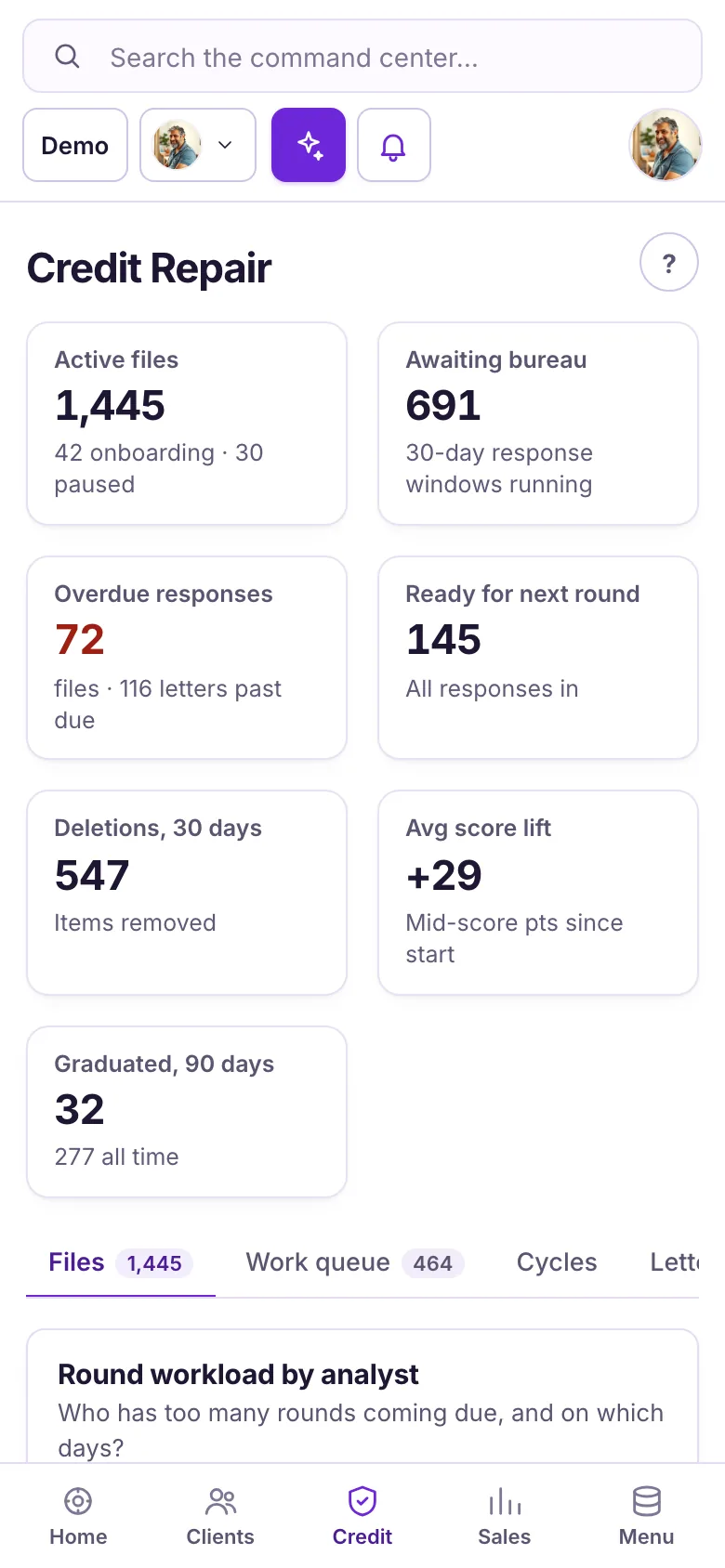
Rounds by bureau and furnisher with response timers, a calendar, the analyst work queue and the next round ready to go when responses land. Overdue responses surface on their own, so nobody has to hunt for them.
Credit monitoring, builder loans, rent and utility reporting and education offers, with a funnel from offered to fulfilled and revenue by product. Offers are optional and never block the repair service, and they go out only after a person approves them.
Twenty-five reports across owner, sales, marketing and operations: recurring revenue with a labeled forecast, deletions and score lift, cancellations and churn, enrollment funnel, advisor leaderboard and analyst workload. Hover for exact values, compare ranges, switch to a table or export CSV.
The onboarding board shows who is waiting on an agreement, documents or a report, and who is ready for round one. Billing covers plans, setup fees released after the first service, refunds, chargebacks and failed-payment recovery.
Educational templates, not legal advice. CreditOps helps your team track and document the work. It does not make a company compliant with the CROA, FCRA, FDCPA, the Telemarketing Sales Rule or state law, and no result is guaranteed: outcomes depend on the bureaus, the furnishers and each client’s file. Have your attorney review agreements, letter templates and marketing for your state.
CreditOps Club is your company’s own branded member site. Anyone can import their own report, track items by bureau, write educational dispute letters and follow their rounds for free, alongside courses, tools and a community. It launches with a 1,000-member starter community so the room is never empty, and that community stays in place as real members join. Every member, lead and call request flows into CreditOps, with upsell hooks for the services your team offers.
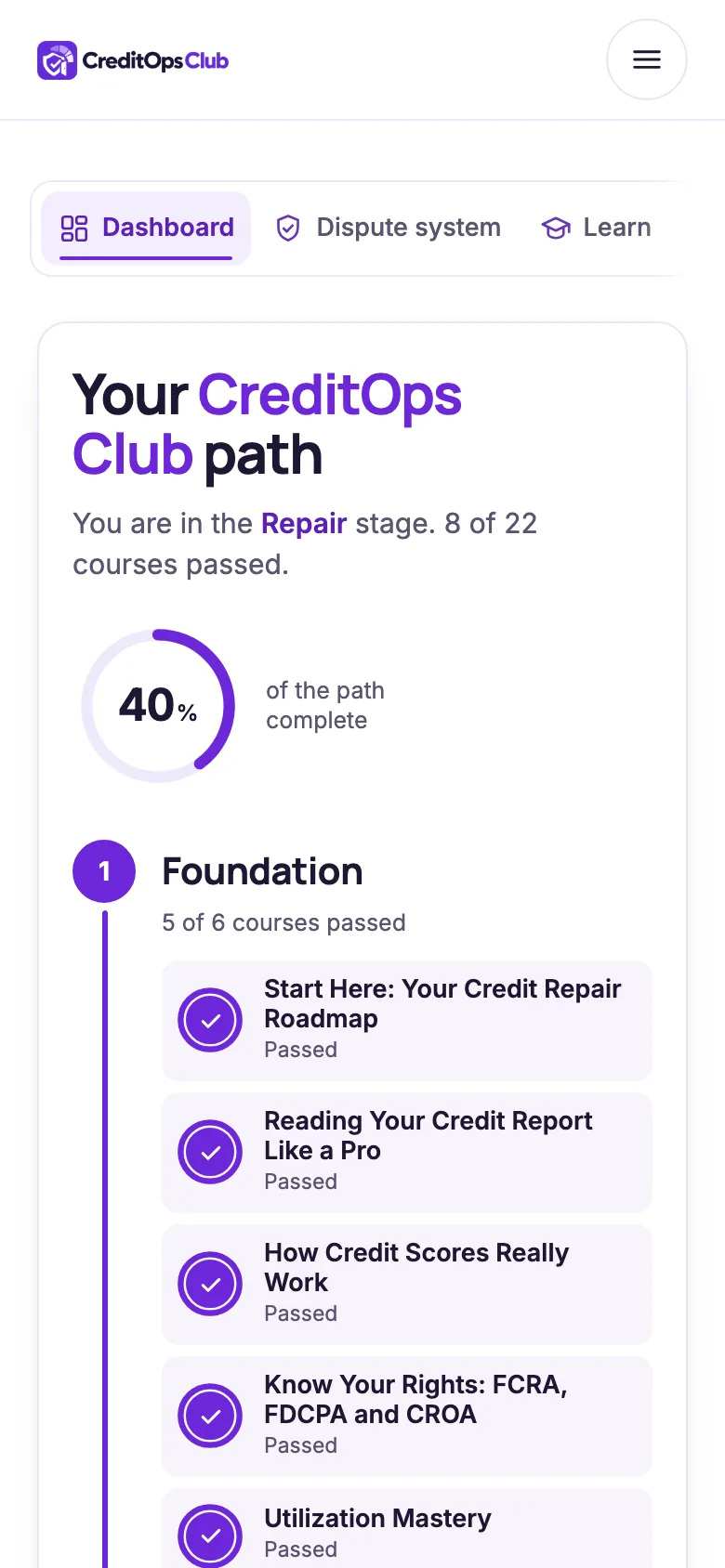
CreditOps Club is an optional add-on to CreditOps, not a separate command center. CreditOps works on its own; add the club when you want a branded member platform feeding your team. It is included only when your proposal lists it.
Dashboard. The member’s path from Foundation to Ready.
Item tracker. Every negative item, by bureau.
Letter Studio. Educational letters with the legal basis named.
Community. A community that is never empty.
Services. Optional services from your team, never a hard sell.
Inside CreditOps. Members and call requests beside client work.
Everyone signs in to the same company and sees what their role needs.
Founder. The whole company, every number.
Client Success Manager. Clients and teams, day to day.
Credit Analyst. Their own book and the letter queue. Shown: the Dispute Engine.
Enrollment Advisor. Their consults and enrollments, with no company money screens. Shown: the enrollment wizard.
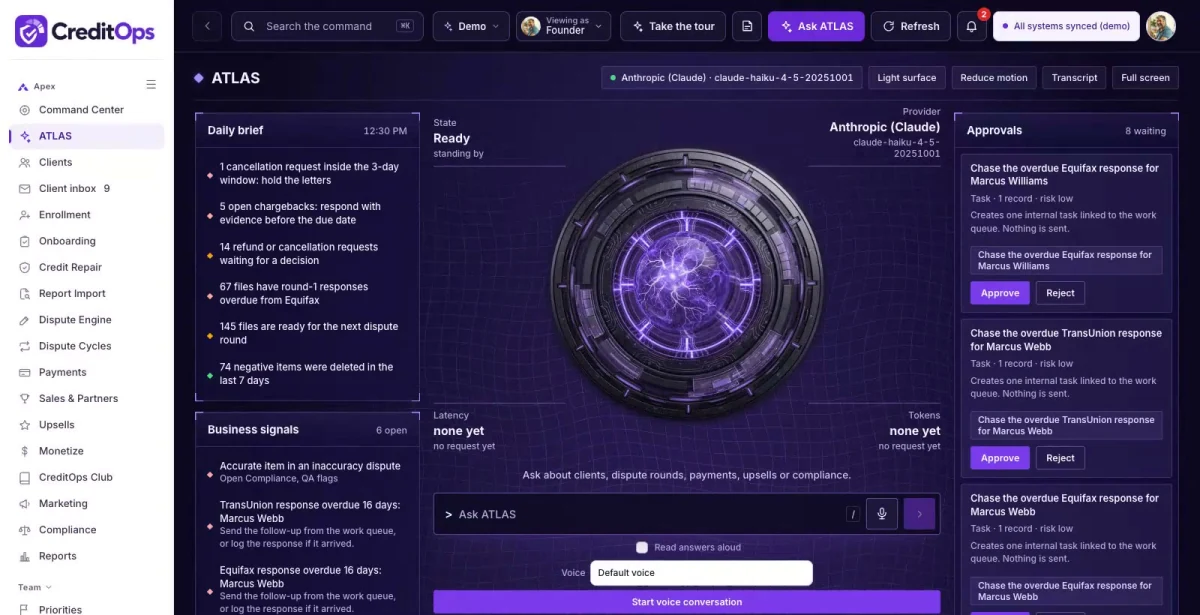
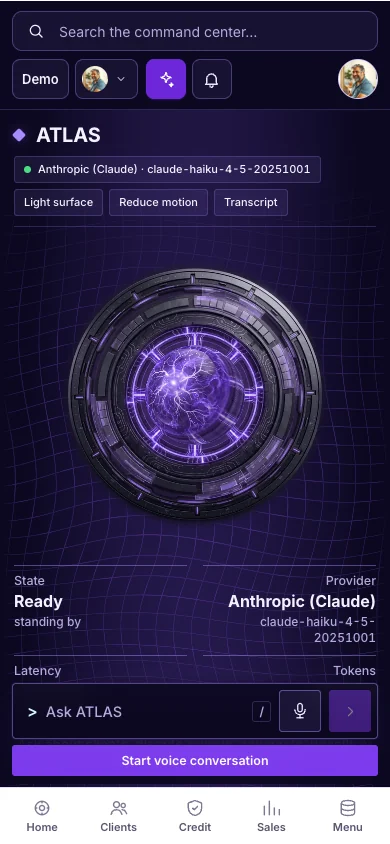
ATLAS writes the morning brief from your own files and answers questions with a link to where to act, from overdue bureau responses to the next dispute round. Answers come from Workers AI by default, running in your own Cloudflare account.
People stay in charge. Letters, offers and proposals are drafts that wait for a person to approve them.
Your own AI accounts, if you want them. You can optionally connect Claude (Anthropic), OpenAI or Gemini. Those connections use your company’s own API accounts and keys, which the providers bill to you separately; a ChatGPT, Claude or Gemini subscription does not include API access. Keys are write-only, a connection counts as connected only after a real test passes, and sensitive data stays off by default. In the public demo, external providers are switched off.
No password. Start with the guided tour, or sign in as a seat in one click. Use the Viewing as switcher at the top of the demo to change seats. Data resets nightly.
We agree the connections in scope, build and test each one, and the Integrations screen shows its real state: connected, degraded or not configured. What each system can share depends on what it publishes.
The optional member club connects natively. ATLAS answers with Workers AI by default.
File import and a webhook receiver for each. We do not claim a direct API where none is published. DisputeBee has a Zapier app.
Its public API covers leads and clients, not disputes, items or letters. We import by file and push leads and clients only once agreed and tested.
Connection slots your company fills with its own accounts. Nothing is called live until it is connected and tested.
No. CreditOps is for your team. Members of the optional CreditOps Club use their own Club site under your brand.
Yes. Every company gets its own private copy of CreditOps and CreditOps Club: its own code, server and database, holding only its own data.
It can run on its own. Credit Repair Cloud publishes a lead and client API only, so we do not claim a live sync of disputes, items or letters. DisputeBeast, DisputeBee, IdentityIQ, SmartCredit and MyScoreIQ connect through file import and webhook bridges. We agree which during scoping and call a connection live only once it is built and tested.
No. It is optional. CreditOps works on its own; CreditOps Club adds a free self-serve dispute system for members that feeds leads and upsell opportunities to your team.
Workers AI answers by default. You can optionally connect Claude (Anthropic), OpenAI or Gemini. Those connections use your own API accounts and keys, billed to you by the provider; a chat subscription does not include API access. ATLAS drafts and suggests, and a person approves.
No. The letters are educational templates. The accuracy guard helps stop accurate information being disputed as inaccurate, but your attorney should review templates, agreements and marketing for your state.
No, and your marketing should not either. CreditOps tracks disputes, responses and outcomes. Results depend on the bureaus, the furnishers and each client’s file. The claims checker flags promises like “guaranteed”.
No. Apex Credit Solutions, its clients and its members are fictional, and the figures are sample data, not results.
It depends on your users, service lines, connections and whether you add CreditOps Club. Book a live demo and we will scope it with you; your proposal lists what is included before you commit.

Book a 15-minute live demo. We will walk through CreditOps and CreditOps Club with your plans and process in mind, and agree what a first scope could look like. Or get a quote.
The same proven foundation, shaped for other industries. Not in one of them? We build yours.
 Every agent, case and commission, in one cockpit, for insurance agencies.Explore InsuranceOps →
 From first dispute to funded, for credit and funding companies.Explore FundingOps →
 Clients, documents, review and filing, for tax and bookkeeping practices.Explore TaxOps →
 Households, reviews and service promises in one cockpit, for advisors.Explore WealthOps →
 Intake, conflicts, matters and deadlines, for law firms.Explore LegalOps →
 Scope, change orders and budgets in one cockpit, for builders.Explore BuildOps →