 Case Study · Website Transformation
A complete digital transformation for Helio Risk, a captive insurance management and enterprise risk consulting firm. We took the firm's existing website and rebuilt the entire experience from the ground up - without changing what Helio Risk actually does.
The homepage. Every page got the same treatment - tap any page below to compare it full screen.
Before a pixel changed, we went through the old site page by page. Six things stood between the firm and the businesses looking for it.
A stock WordPress theme didn’t reflect the weight of what the firm actually does - managing captive insurance programs and enterprise risk for real companies.
A theme built for a generic blog, not a professional-services firm someone is researching on their phone before a call.
Services, industries served and the team weren’t consistently positioned as obvious next steps on every page.
Heather McClure, Kyle Sweet, Blake Kerr and nine staff members were introduced with a name, a title and a headshot - nothing that showed who they actually are.
The hidden layer search engines read said the same generic thing on every page - no page ever declared itself as a contact page, an about page or an FAQ.
No FAQ page, no FAQ schema, and a robots.txt that never named a single AI crawler - nothing for an assistant to quote when recommending a captive manager.
We saved a copy of the old site and audited it - and we’ll tell you what it did right, too. Here is the honest scorecard, old versus new.
Every row above was checked on saved copies of both sites, captured the same day. Where the old site already did something right - canonicals, page titles, even a working sitemap index - the table says so.
Tap a page to open the full-screen comparison - live sites, video playing, drag to reveal.
Every partner and staff member on the old site was a name, a title and one photo. On the new site, each one has a real video introduction - captured from the firm's own footage, not a stand-in. Drag the example, then tap anyone below to see their transformation.

watch her come alive Heather McClure, Managing Partner & General Counsel. Left: the static team photo. Right: the same person, on video.
So the redesign was built for the phone first. The left screen is a same-day recording of the old site at iPhone size. The right screen is the new site itself, at phone size.
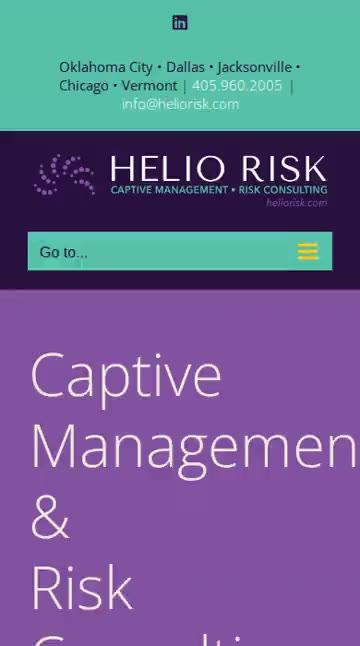
On the new site, every action above is one tap from any page - the firm's phone number dials directly, and every office routes straight into Google Maps.
Anyone can make a website look more professional. The layer underneath - the one Google and AI assistants actually read - is where this redesign does its quietest work.
What most professional-services firms have and never know it
What we give every client
We didn’t just redesign what visitors see.
We rebuilt what Google and AI systems see too.
Every figure above was counted on saved copies of both sites, captured the same day. We don’t promise rankings - nobody honestly can. We build sites that search engines and AI assistants can actually read, which is what rankings are built on.
Here is what was actually delivered.
All 9 pages designed around what Helio Risk actually does - not a template with new colors.
Layouts tuned separately for small screens, where first impressions of the firm are usually made.
Call, discuss a risk strategy, or reach a specific team member - positioned on every page.
Look at the Helio Risk logo on this very page - it isn’t a static image. It’s a live, code-animated SVG that moves the instant the page loads, on every page of the new site.
Every partner and staff member recorded on video - not a headshot, not a stand-in.
Titles, descriptions, headings, canonicals, sitemap and robots directives on every page.
Business type, address, phone and offices written in the format Google reads.
A 26-question FAQ structured so assistants can quote it directly.
Instead of treating Helio Risk like a generic professional-services site, the new build gives each part of the business its own place to make its case. Tap any of them to compare that page, before and after.
Each card above is a real page on the new site, with its own content, its own video and its own path to reach the firm.
No made-up traffic charts. Just what is finished, checked and waiting for the go-ahead.
Dated template look
Same generic label on every page
Team shown as headshots only
A meta description 9 characters long
No FAQ page in a form AI can read
Hard for AI assistants to read
Designed around the firm’s real work
Every page declares what it is
Team brought to life on video
Every description written with intent
26 answers AI can quote
Readable by Google & AI
Send the link to the site you have today. That’s the whole assignment.
Design, your photos turned into video, and the full search & AI setup - typically inside 48 hours.
You review your new site at a private link - exactly like this page - before it ever replaces your current one.
Real questions someone would type into Google or ask an AI assistant when deciding whether a website needs a rebuild.
Pricing depends on scope, and it's discussed directly rather than posted here - every business is different.
For Helio Risk, the full 9-page rebuild - captive services, industries, team, press, FAQ and the rest - was built and staged at a private preview link before anything went live.
Not when it's done correctly. Titles, descriptions and canonical URLs carry over page by page, and nothing about a redesign forces Google to forget a site exists.
Schema is a hidden layer of code that tells Google and AI assistants exactly what a page is - a firm's contact page, its about page, its FAQ - instead of making them guess from the visible text.
Two things help most: a robots.txt that explicitly welcomes AI crawlers by name, and an FAQ section written in the plain question-and-answer shape those assistants pull from.
By whether real people on a real phone can read the text, tap the right button and watch the video without stalling out - not just whether the layout resizes.
A custom build means every page is written and structured around the specific business - its real services, its real team, its real service area - not a generic layout with the name swapped in.
An FAQ page helps a lot, mainly because it answers the exact questions people type into a search bar or ask an AI assistant, in the same words they use.
Structured data, one clear heading per page, descriptive alt text on images, and a sitemap that lists every real page - all invisible to a visitor, all read by a crawler.
Faster is better for both visitors and crawlers. Helio Risk's rebuilt homepage loads a little over half the data the old homepage did.
Design is how a page looks and works. SEO is whether search engines and AI assistants can actually read and understand it. A redesign should do both, not just the first one.
It helps, but it isn't required. Existing photos, bios and site copy can be pulled from the current site and refined, the way Helio Risk's own team photos and bios were carried over and given a video treatment.
The site keeps being edited as the business changes - a new hire, a new press mention, an updated process - rather than sitting untouched until the next full redesign.
Yes - if anything, more than most. Fewer people search 'captive insurance formation' by typing it into Google versus asking an AI assistant to explain it and recommend a firm, so being readable by that assistant matters.